
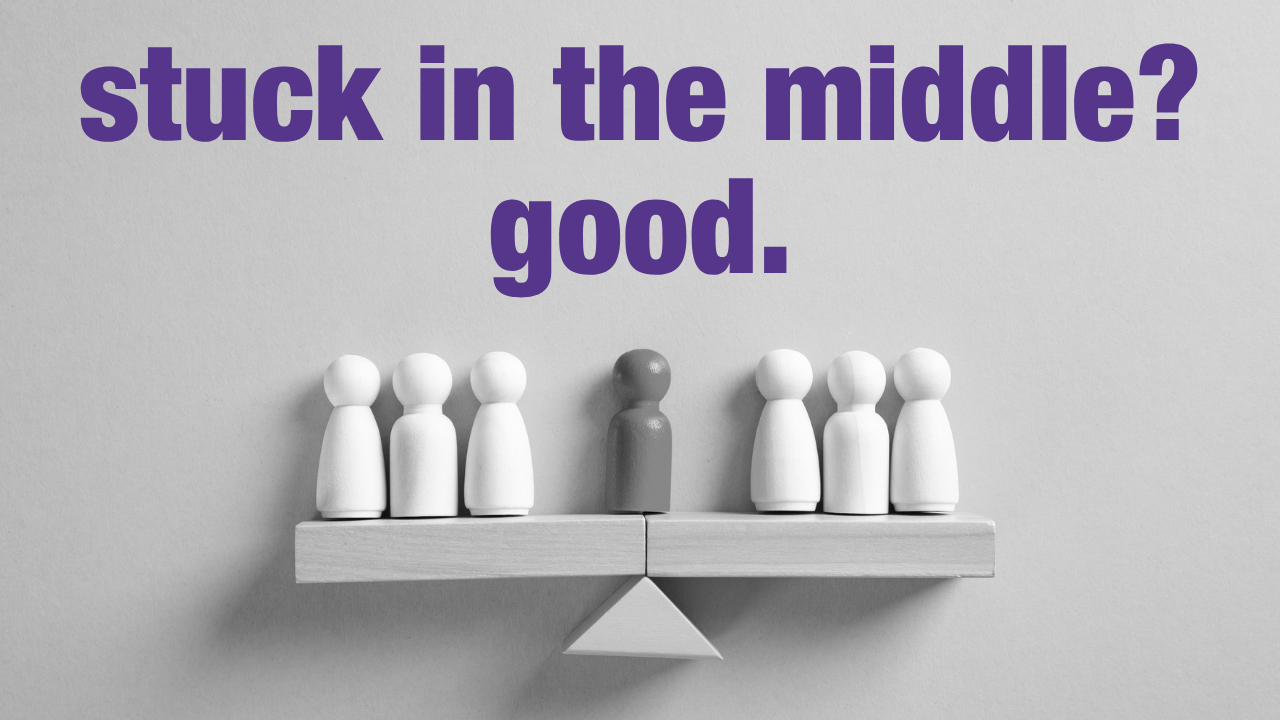
One of the things I am noticing in this environment of constant restructures, cost pressures, hybrid work, competing priorities and uncertainties, is that people are fleeing back to their own functional expertise, or their particular level, be it executive, middle or frontline.
Back into the assured safety of our caves.
As a result, organisations are becoming more disconnected. Silos are becoming even stronger. Boundaries are becoming more permanent. And enterprises are not reaching the capacity they are truly capable of.
In the middle of all this, the role of the middle manager has never been more important.
They are often the ones expected to translate strategy into action, keep people connected across boundaries, and make sense of decisions they may not have made themselves.
“Who are those people at the top? What were they thinking?”
It is a difficult role to play well, and it is a role that most of us will have to play at some point in our lives.
I think my first experience of being in the middle started much earlier than I realised.
One of my first leadership roles was Vice Captain of North Ryde Public School.
Brave little Mitch.
Greg Crompton was Captain. I did not know it back then, but it was going to be my first experience of middle management, of being a 2IC.
Greg knew when he was to speak at school assembly, talk at Parents and Citizens meetings, and present at school plays.
But I also had to be there. I had to be ready to take over if Greg was sick or could not make it for any reason. Just in case. I was the backup. I never knew when I would be called upon. As a primary school student, this felt like a lot of pressure.
I never realised at the time that this uncertainty was exactly the issue many of the mid-level managers I’ve been coaching are facing.
Seconds in command in business often experience unique stress levels.
Although C-suite executives have final authority, it is often the mid-level leaders who have responsibility for making things happen, while lacking the final say in major decisions.
Translating strategy into action, being a buffer, trying to explain what can often seem like crazy decisions from the top to the troops.
It takes its toll.
The uncertainty can lead to burnout, resentment, switching off, a chronic sense of lack of control, dealing with C-suite politics, a lack of alignment, and at times the impulsivity of the big boys and girls.
So how do we at least reduce this uncertainty and angst?
For me, the breakthrough came when I went to Cape Cod and spent time with Barry Oshry from Power & Systems, one of the real pioneers in systems thinking.
Barry’s work helped me understand the power of middle dynamics.
People in the middle are not powerless.
In fact, they are often in one of the most powerful positions in the system, if they understand how to use that position well.
Middle managers have a unique perspective. They have a better understanding and much more access to the strategy than frontline people, and they certainly have a better understanding of what frontline people are dealing with compared to executive or senior management.
The most valuable thing middle managers can do is bring the whole system together, so the left hand knows what the right hand is doing.
They can connect what is disconnected.
They can carry information up, down and across the enterprise.
They can help senior leaders understand the reality of implementation.
They can help frontline teams understand the broader strategy.
It takes courage, skills and a broader perspective.
And it takes agency.
It is imperative to make a stand when in the middle.
Don’t ever think you don’t have agency.
Make a stand on your own values and what is best for the overall enterprise. Push back when you need to. Speak up when strategy or activities don’t make sense.
And if you are a senior manager with middle managers reporting to you, encourage them to push back on you. And listen. Really listen.
The last thing you want is to be surrounded by “yes” people.
One of the joys of our program Higher Ground: Leadership Mastermind is seeing a number of middle managers go through the program and be promoted.
Why?
Because they gain new skills and broader perspective and, with the support of the cohort and faculty mentors, build both their competence and their confidence.
As a result, they feel more empowered to take a stand on important issues, become more assertive, speak up more effectively, and push back when they believe a strategy or activity is not appropriate.
This is what makes a difference to organisations.
It’s also what gets people promoted.
In Higher Ground, we face right into this challenge through a trusted cohort of like-minded peers, practical management tools and ideas, honest challenge, broader perspective, and a lot of support around emotional regulation.
Yes, you may already have internal leadership development opportunities. And they matter.
But this is something different.
It does not have to be Higher Ground, but it does need to include some exposure beyond your own walls.
You cannot always get this from internal training alone. There is something powerful that happens when high-performing leaders step outside their own organisation and sit with peers from other cultures, industries and ways of thinking.
They hear different assumptions.
They see different systems.
They are challenged by people who do not share the same internal politics or inherited habits.
That is often where the breakthroughs happen.
We have less than a handful of places left starting face-to-face in Sydney from 8th July.
If you or one of your leaders would benefit from more courage, perspective, support and agency in the middle, email our team via soul@thehumanenterprise.com.au
Until Next time…
Find the passion.
Develop the skills.
Make the numbers.
Make a difference.

Paul Mitchell
“APAC’s most respected transformational leadership performance coach”
Paul Mitchell (@Paul_S_Mitchell) is a speaker, author, transformational leadership coach and founder of the human enterprise. Through leadership coaching, leadership development programmes, keynotes and facilitation, Paul works with organisations to build cultures where everybody leads.

